
I’ll be honest with you: when I first heard about founders running entire businesses with AI, I was skeptical. How could software replace the human touch that makes a business thrive? But here’s what I’ve learned—AI isn’t about replacing humanity. It’s about amplifying and complementing what one person can accomplish.
For small and medium business founders like us, AI represents something revolutionary: the ability to compete with companies ten times our size without hiring a massive team. We’re living in an era where a non-technical founder can orchestrate an entire business operation from their laptop, with AI handling everything from customer inquiries to product development. This isn’t science fiction—it’s happening right now, and founders who embrace this shift early will have an enormous competitive advantage.
The beauty of AI-powered business operations lies in its accessibility. You don’t need a computer science degree or a hefty budget. What you need is curiosity, willingness to experiment, and the right toolkit. Let me walk you through how different departments can be transformed by AI, and how I see this working in practice.
But, what happens to the human factor? The conscience, the emotional intelligence, the critical decision making, the final call…
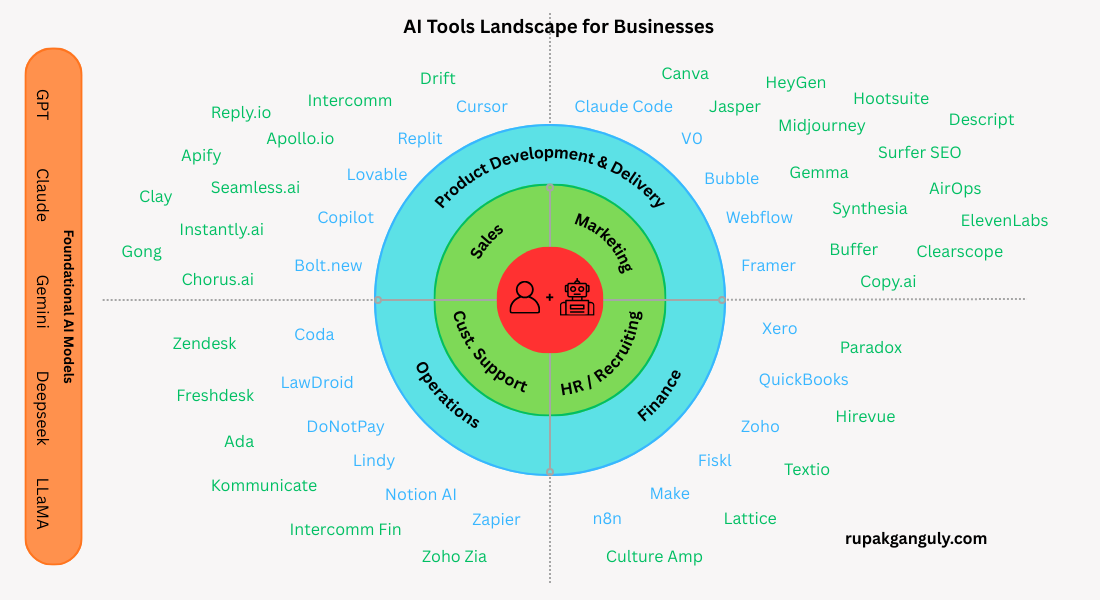 [The ever-growing AI tools landscape for businesses]
Sales: Your 24x7 Revenue Engine
Imagine having a sales team that never sleeps, never takes vacation, and gets smarter with every customer interaction. That’s what AI brings to sales.
Tools like Drift and Intercom power AI chatbots that engage website visitors instantly, qualify leads based on your criteria, and even schedule demos. I’ve seen these systems handle initial conversations so naturally that prospects don’t realize they’re chatting with AI until they’re transferred to the founder for closing.
Lead generation is another big gap that AI tools can help fill. Tools like Apollo.io have access to large B2B contact database, and help with sequencing & AI-assisted outreach. Seamless.AI can turn domains or partial contacts into full profiles and push them into your CRM. And if you are a bit technical, you can also explore Apify for scraping leads.
For outreach, Reply.io and Instantly.ai automate email sequences with personalization that feels genuinely human. They A/B test subject lines, adjust sending times based on engagement patterns, and follow up persistently without being pushy. Meanwhile, Clay helps you build targeted prospect lists by enriching data from multiple sources—LinkedIn, company websites, news mentions—so you’re always reaching out to the right people at the right time.
The game-changer? Gong or Chorus.ai can analyze your sales calls, transcribe them, and provide coaching insights. For a solo founder, this means you can review what worked and what didn’t without hiring a sales manager.
Marketing: Content Creation on Autopilot
Marketing used to require an entire team. Now, one founder with the right AI tools can execute a multi-channel strategy that rivals agency-level work.
ChatGPT, Claude, and Jasper can draft blog posts, social media content, email campaigns, and ad copy in minutes. I’m not talking about generic robot-speak—with proper prompting, these tools produce content that reflects your brand voice, personal tone, and resonates with your audience.
For visual content, Gemma, Canva’s Magic Design and Midjourney generate professional graphics and marketing materials without a designer. Synthesia, HeyGen and Descript create video content with AI avatars, perfect for product demos or explainer videos when you don’t want to be on camera.
ElevenLabs focuses on making AI-generated audio a practical growth lever for marketers by turning text into realistic, emotionally expressive voice content at scale. It also supports interactive campaigns, voice-led customer engagement, and more human-like shopping or support experiences that can lift conversion and retention.
Social media management? Buffer and Hootsuite with AI features schedule posts at optimal times and suggest content based on what’s trending in your industry. Copy.ai specifically helps with ad copy variations for A/B testing across platforms.
SEO doesn’t have to be a mystery either. Surfer SEO and Clearscope or AirOps, use AI to optimize your content for search engines, telling you exactly what keywords to include and how to structure articles for maximum visibility.
HR and Recruiting: Building Your Team Without the Headaches
Even if you’re mostly running on AI, you’ll eventually need human teammates. AI makes hiring dramatically more efficient.
Paradox offers an AI assistant named Olivia that screens candidates, answers their questions, and schedules interviews. It handles the repetitive parts of recruiting so you can focus on actually evaluating talent. HireVue uses AI to analyze video interviews, assessing candidates’ communication skills and cultural fit based on language patterns and responses.
For job description writing and candidate outreach, Textio optimizes your language to attract diverse, qualified applicants. It flags biased language and suggests alternatives that broaden your talent pool.
Once you have a team, Lattice and Culture Amp use AI to gather employee feedback, predict turnover risks, and suggest interventions before someone decides to leave. These platforms help you stay connected to team sentiment even when you’re juggling a dozen other priorities.
Product Development: From Idea to Launch
This is where AI truly shines for technical and non-technical founders alike. You can now build functional products without writing a single line of code.
Claude Code, Cursor, GitHub Copilot, Lovable, Bolt.new and Replit help with coding, whether you’re building a web app, mobile application, or backend system. These tools don’t just autocomplete—they understand context and can generate entire functions or components based on plain English descriptions.
For no-code solutions, Bubble, Webflow, and Framer with AI assistance let you design and deploy websites and web apps through visual interfaces. v0 by Vercel generates user interface components from text descriptions, which you can then customize.
Product research is faster too. Dovetail analyzes customer interviews and feedback using AI, identifying patterns and insights you might miss. Maze conducts user testing and provides AI-powered analysis of where users struggle in your product experience.
I have extensively experimented and written about using AI no-code and low-code tools to develop website and apps.
- Building a web app using AI without the prompt engineering headaches
- Exploring AI Assisted Development: Building a Feature Rich Web App With Bolt.new
- Practical Guide to AI Assisted Development: Enhancing a Web App With Cursor AI
- Exploring AI Assistants: Building a Rails app With Cline AI and Deepseek Model
- Exploring V0 AI-Powered Code Assistant: Building a Flashcard App
- Building a Habit Tracker App With Lovable AI: A Step-by-Step Tutorial
Customer Support: Scaling Without the Team
A solo-founder or a small business owner cannot be running the business and keep an eye on the customers to provide the support they deserve. Nothing frustrates customers more than slow support responses or no response at all. AI solves this while maintaining quality.
Zendesk and Freshdesk with AI capabilities automatically categorize tickets, suggest responses based on your knowledge base, and route complex issues appropriately. Ada and Kommunicate create intelligent chatbots that resolve common issues instantly—password resets, order tracking, basic troubleshooting—without human intervention.
The surprising part is that Intercom’s Fin and Zoho’s Zia AI agents can actually resolve complex queries by pulling information from your documentation, past tickets, and product database. They know when to escalate to you, but they handle far more than you’d expect.
Operations and Finance: The Backend That Runs Itself
Administrative tasks are the silent time-killers. AI handles them while you focus on strategy.
QuickBooks and Xero with AI features automate bookkeeping, categorize expenses, and even predict cash flow issues before they become critical. Fiskl uses AI to automate accounting tasks and chase late-paying clients politely but persistently via automated reminders.
Notion AI, Lindy and Coda become your operational brain—drafting meeting agendas, creating project plans, and even writing standard operating procedures based on your descriptions. Zapier, n8n and Make connect all your tools, creating automated workflows where data flows seamlessly between systems without manual data entry.
For legal needs, LawDroid and DoNotPay handle contract reviews, terms of service generation, and routine legal questions, saving you thousands in attorney fees for standard tasks.
The Critical Role of Human-in-the-Loop: Why You’re Not Replaceable
Let me be crystal clear about something that often gets lost in all the AI hype: you are not automating yourself out of existence. You’re elevating your role to where it matters most.
The human-in-the-loop is fundamental to making AI work effectively in business. Think of AI as an incredibly capable intern who can process information at superhuman speeds but still needs your judgment, intuition, and strategic direction.
For instance in sales, AI can’t sense that a prospect’s hesitation comes from internal politics or budget timing—that requires human emotional intelligence. In marketing, when a crisis hits your industry, AI might suggest tone-deaf content because it lacks real-world context about what your customers are experiencing right now. That’s where your industry experience and finger on your customer’s pulse comes into play. All your AI workflows and automations need to have a human making the critical decisions, tweaking content and making the final call.
This supervision isn’t a weakness of AI—it’s the entire point. You’re creating leverage. Instead of spending eight hours doing routine tasks, you spend one hour reviewing AI outputs and making the decisions that actually require human judgment. That’s seven extra hours for strategy, relationship-building, and creative problem-solving that AI can’t do.
The review process becomes your superpower. This takes minutes, not hours, but it’s non-negotiable. The founders who succeed with AI aren’t the ones who set it and forget it—they’re the ones who establish clear quality standards and consistently enforce them.
Complex situations demand human nuance, wisdom and emotional intelligence. AI struggles with ambiguity, competing priorities, and ethical gray areas. When a client requests something that’s technically possible but might not serve their best interests long-term, that’s a judgment call requiring wisdom, not computation. When market conditions shift and you need to pivot strategy quickly, AI provides data but you make the call.
The most successful AI-powered businesses I’ve seen treat AI as a force multiplier for human judgment, not a replacement. The founder or the business owner remains the decision-maker, strategist, and quality controller. AI just makes them capable of executing at a scale that would otherwise require a team of 20.
AI requires oversight, not absence. These tools work best with human guidance. You’ll need to review outputs, refine prompts, and step in for complex situations. Think of it as supervision rather than abdication. You’re conducting an orchestra, not pressing play on a recording.
The Numbers Don’t Lie: Cost Implications
Let’s talk about costs, because that’s what matters when you’re bootstrapping a business. Let’s look at a high-level practical break down of the costs of running an AI-powered operation versus hiring a traditional team.
| AI-Powered Monthly Costs | Traditional Team Monthly Costs |
|---|---|
| Sales tools (Drift, Reply.io, Clay): $200-400 | Sales representative (1): $4,000-6,000 + commission |
| Marketing suite (Jasper, Canva Pro, Buffer): $150-300 | Marketing coordinator (1): $3,500-5,000 |
| Customer support (Zendesk with AI, chatbot): $100-200 | Customer support rep (1): $2,500-4,000 |
| Product development (Cursor, GitHub Copilot, Bubble): $100-200 | Junior developer (1): $5,000-8,000 |
| HR/Recruiting tools (Paradox, applicant tracking): $100-150 | HR/Admin assistant (0.5): $1,500-2,500 |
| Operations (QuickBooks, Zapier, Notion): $100-200 | Operations/Finance coordinator (0.5): $1,500-2,500 |
| Total monthly AI stack: $750-1,450 | Total monthly payroll: $16,500-25,500 |
| Annual cost: $9,000-17,400 | Annual cost: $198,000-306,000 |
| No extra money spent for benefits etc. | Add 25-35% for benefits, taxes, equipment: $247,500-412,000 |
Note: Your mileage might vary depending on the AI usage and qualification of the human personnel.
The difference is staggering. Even with a robust AI toolkit costing $1,500 per month, you’re spending roughly 94% less monthly than hiring a minimal team. Additionally, $250,000-$415,000 annually that stays in your business for growth, product development, or your own runway.
But here’s the nuance: AI tools handle volume and repetition brilliantly, but they don’t replace strategic thinking or complex problem-solving. As you scale past $500K-1M in revenue, you’ll likely need to hire specialists for areas requiring deep expertise.
The beauty is that you can reach that revenue threshold as a solo founder with AI by your side, whereas traditionally you’d need the team first and hope to grow into profitability.
Think of it this way—AI gives you the option to stay lean longer, validate your business model thoroughly, and hire humans strategically rather than out of desperation.
Key Takeaways for Founders and Business Owners
After exploring this AI-powered business model extensively, here are the things that stands out in my perspective:
The founder’s / business owner’s role fundamentally shifts. You become an orchestrator and strategist rather than an executor. Your job is to set direction, make key decisions, and ensure quality—not to do every task yourself.
Start small and scale gradually. Don’t try to automate everything at once. Pick one area, master those tools, and then expand. I’d recommend starting with either sales or customer support, as these provide immediate ROI.
AI requires oversight, not absence. These tools work best with human guidance. You’ll need to review outputs, refine prompts, and step in for complex situations. See it as oversight, not walking away.
The cost savings are substantial but not total. Most AI tools cost $50-500 per month. A fully AI-powered operation might run $2,000-5,000 monthly across all departments—expensive for a solopreneur, but a fraction of hiring even one employee.
The Honest Assessment
Pros:
- Unprecedented scalability: Handle customer volumes that would normally require a team of 10-20 people
- 24x7 operations: Your business never sleeps, serving global customers across time zones
- Lower overhead: Dramatically reduced payroll, office space, and HR complexity
- Faster execution: Launch campaigns, features, and initiatives in days instead of months
- Data-driven decisions: AI tools provide analytics and insights that inform every choice
Cons:
- Learning curve: Each tool requires time to master, and the landscape changes constantly
- Lack of human intuition: AI sometimes misreads emotional nuance or cultural context
- Dependency risk: If a critical AI service goes down, your operations suffer
- Quality variability: AI outputs need review—occasionally you’ll get nonsensical results
- Lonely journey: Running a business alone, even with AI support, can be isolating
Final Observations
Is an AI-powered business the future? Absolutely. Is it for everyone? Well, that’s more nuanced.
This model works best for founders who are comfortable with technology, self-motivated, and excited by continuous learning. You need to enjoy problem-solving and not mind the trial-and-error process of finding the right tools and workflows.
What surprised me the most is how creative you can be with these systems. AI doesn’t limit your vision—it expands what’s possible with limited resources. The businesses I’ve seen thrive with this approach are those where the founder treats AI as a collaborator, not just blind automation.
The competitive landscape is shifting. Traditional businesses with large teams and overhead will struggle against lean, AI-powered competitors who can move faster and charge less. As a founder, you have a choice to make. Embrace these tools now while you have the advantage of agility, or wait until everyone else catches up.
Next Steps
My honest advice is that you start experimenting today. Pick one AI tool, commit to mastering it, and see what becomes possible. You might surprise yourself with what you can build when you’re no longer constrained by the number of hours in a day or hands on deck.
The future of entrepreneurship isn’t about replacing humans with machines. It’s about empowering individual humans to accomplish what previously required an army. That’s not just efficient—it’s democratizing. And for founders willing to embrace it, it’s incredibly exciting.
How I Can Help You Navigate This Journey
I understand that reading about AI automation and actually implementing it are two very different things. That’s exactly why I work with small and medium businesses to design and deploy custom AI workflows that fit their unique needs.
Whether you’re looking to automate your sales follow-ups, streamline customer support, or build content marketing systems that run themselves, I help founders cut through the noise and focus on what actually moves the needle. I’m not selling you every tool under the sun—I’m helping you identify the 3-5 strategic automations that will transform your operations and give you back your time.
The best part is that you don’t need to be technical or do it all by yourself. I can help translate AI capabilities into practical business outcomes, set up the systems for you, and ensure you’re confident managing them going forward. Think of it as having a technical co-founder on demand, without the equity or long-term commitment.
If you’re curious about what’s possible for your specific business, I’d love to have a casual conversation. No pressure, no sales pitch—just an honest discussion about where you are, where you want to go, and whether AI automation makes sense for your journey.
Feel free to grab time on my calendar: Schedule a chat